Introduction
Cheddar cheese is one of the most popular cheeses in the world, known for its rich flavour, firm texture, and incredible versatility. But what many people don’t realise is that its origins lie deep within the caves of Somerset, England — specifically in the area around Cheddar Gorge.
The traditional process of making Cheddar is both an art and a science, refined over centuries. In this guide, we’ll walk through exactly how Cheddar cheese is made, from fresh milk to the mature blocks you find on your plate.
Step 1
Everything begins with high-quality milk, usually from cows grazing on lush Somerset pastures.
The milk is:
Pasteurised (in most modern production)
Gently warmed
Combined with starter cultures (beneficial bacteria)
These cultures begin converting lactose into lactic acid — the first step in developing Cheddar’s distinctive flavour.
Step 2
Next, rennet is added — a natural enzyme that causes the milk to coagulate.
Within about 30–40 minutes:
The liquid milk thickens
A soft gel forms
This is then cut into small cubes
These cubes separate into:
Curds (solid)
Whey (liquid)
Step 3
The curds are carefully cut and slowly heated.
This step:
Releases more whey
Firms up the curds
Begins shaping the final texture
The temperature and timing here are crucial — they directly influence whether the cheese ends up mild, sharp, crumbly, or smooth.
Step 4
This is what makes Cheddar… Cheddar.
The curds are:
Drained of whey
Stacked into slabs
Repeatedly turned and piled
This process:
Removes additional moisture
Develops the cheese’s signature dense texture
Enhances flavour development
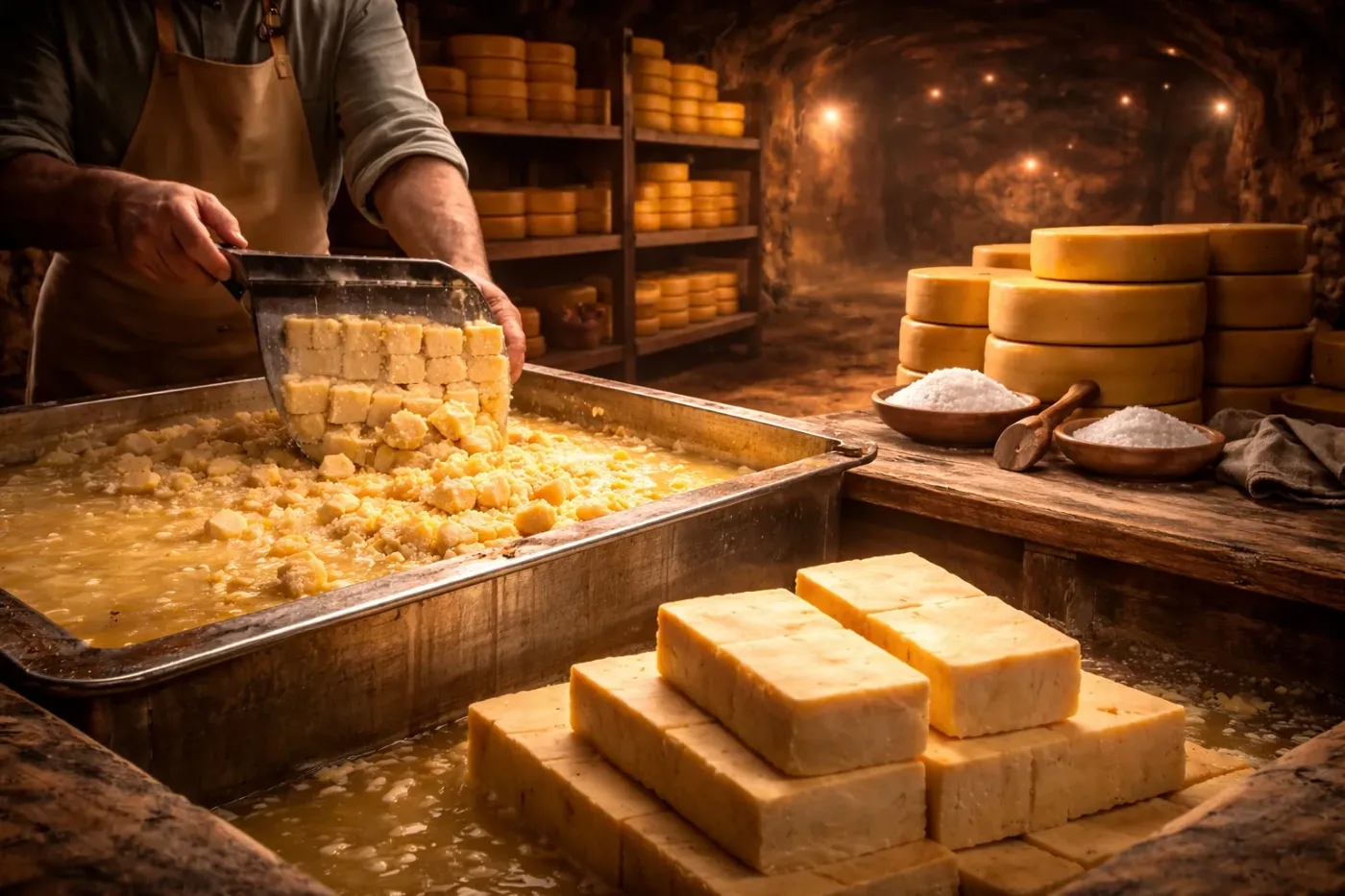
After this, the slabs are milled into smaller pieces and salted.
Step 5
Salt is added for both:
Flavour
Preservation
The curds are then:
Placed into moulds
Pressed into solid blocks or wheels
Pressing removes any remaining whey and helps form the familiar shape of Cheddar.
Step 6
Now comes the magic.
Cheddar is aged anywhere from:
3 months (mild)
To 2+ years (extra mature)
Traditionally, this happened in the cool, stable environment of caves in Cheddar Gorge.
During aging:
Flavour deepens
Texture becomes firmer or crumbly
Natural crystals may form in older cheeses
These cave conditions — cool, humid, and consistent — are one of the reasons Cheddar from this region became so famous.
What Makes Cheddar Unique?
Several things set Cheddar apart from other cheeses:
The cheddaring process
Its firm, sliceable texture
A flavour that ranges from mild and creamy to sharp and tangy
Its ability to age beautifully over time
A Curious Local Detail…
For centuries, these cheeses were stored deep inside caves — quiet, dark, and undisturbed.
Most of the time, nothing unusual happened.
…but every now and again, something did go slightly wrong.
(Though that’s a story for another post.)
Conclusion
From fresh milk to carefully aged blocks, Cheddar cheese is the result of a time-honoured process that has remained largely unchanged for generations. Whether produced traditionally in Somerset or modern dairies around the world, the core steps remain the same — and the results are unmistakable.
Next time you enjoy a slice of Cheddar, you’ll know exactly what went into making it.