Introduction
Cheddar Gorge is known for its towering cliffs, winding caves, and world-famous cheese. But long before tourists arrived with cameras and hiking boots, this landscape held something far more ancient and far more mysterious.
Beneath the surface, hidden within the cool, dark caves, lies a story that stretches back thousands of years. A story of survival, discovery and perhaps something a little harder to explain.
At the centre of it all is one of Britains most famous prehistoric figures: the Cheddar Man.
Who Was the Cheddar Man?
The Cheddar Man is the oldest nearly complete human skeleton ever discovered in Britain. He was found in 1903 in Goughs Cave, deep within Cheddar Gorge, and is believed to have lived around 10,000 years ago.
For decades, he remained something of a mystery. But modern science has revealed surprising details about him. DNA analysis suggests he likely had dark skin, blue or green eyes, and lived as a hunter-gatherer in a world still recovering from the last Ice Age.
He would have known the gorge not as a place of beauty or tourism, but as a place of survival.
Life in the Caves
In ancient times, Cheddar Gorge offered one crucial advantage: shelter.
The caves provided:
Protection from harsh weather
A safer place to sleep and store food
A stable environment in an unpredictable world
Archaeological discoveries suggest that people did not simply pass through the gorge they lived there, adapting to its dark, cold, but dependable conditions.
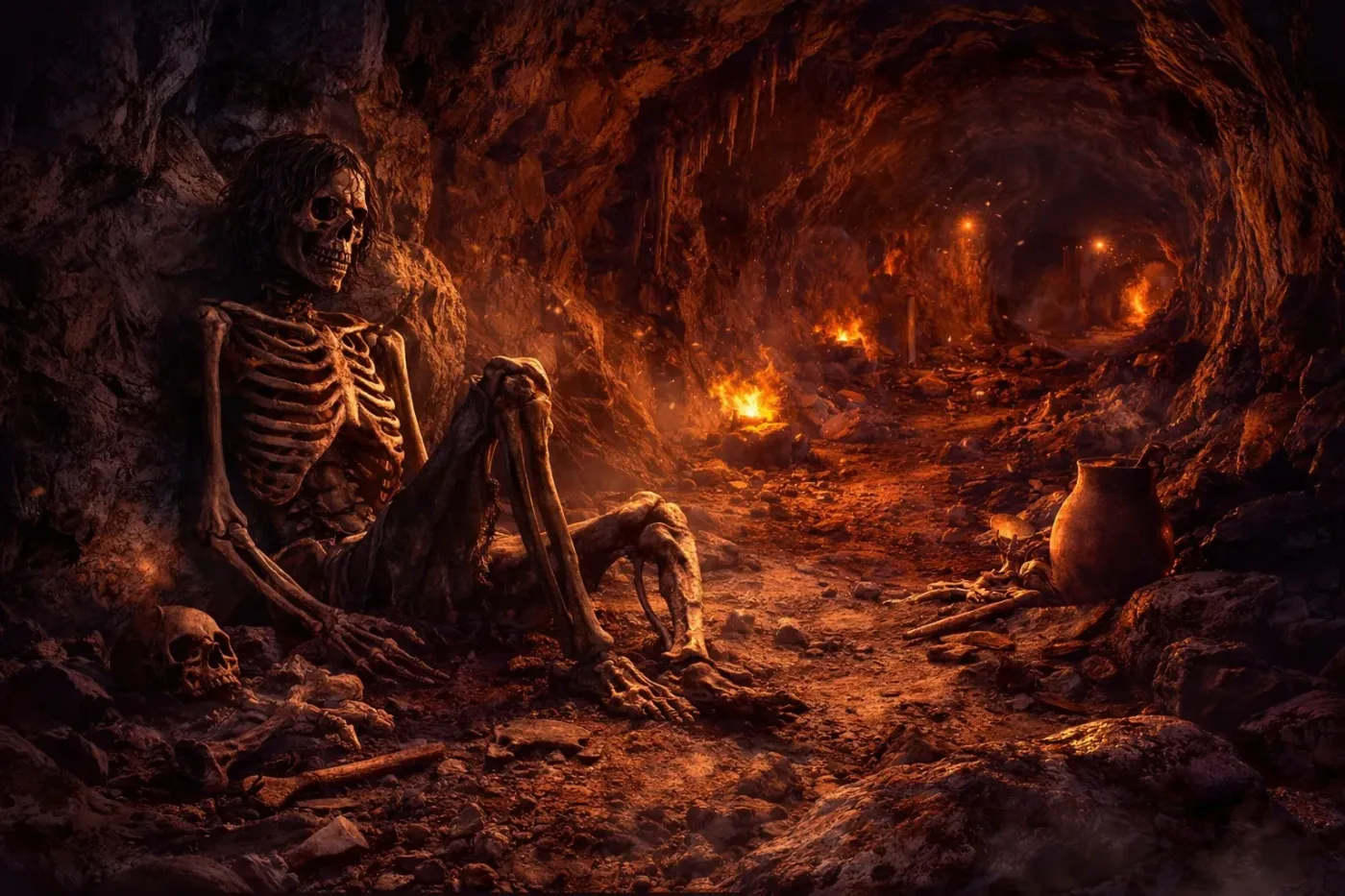
Inside the caves, fires would have flickered against the walls. Shadows would have danced. Sounds would have echoed in strange and unpredictable ways.
And sometimes things may not have been as still as they seemed.
Strange Discoveries and Unanswered Questions
Over the years, the caves of Cheddar Gorge have revealed more than just bones.
Archaeologists have uncovered evidence of unusual activity including signs that some early humans may have practised ritual behaviour, or even cannibalism. Marks found on bones suggest that bodies were carefully processed, not simply buried.
Why? No one knows for certain.
Some historians believe it was a matter of survival. Others think it may have had symbolic or cultural meaning.
Even today, the caves continue to raise more questions than answers.
A Place That Does Not Like to Be Found
Local stories speak of something else entirely.
Visitors have long reported strange sensations deep inside the caves sudden chills, a feeling of being watched, or the unsettling sense that the landscape itself is shifting. Paths that seem familiar suddenly feel different. Landmarks appear then disappear.
There are even tales of people returning to find that entrances they once used are no longer there. Most dismiss these stories as tricks of light, sound, and imagination.
But not everyone does.
A Curious Local Detail
For centuries, the caves of Cheddar Gorge have also been used to store cheese, taking advantage of the cool, constant conditions deep underground.
Most of the time, nothing unusual happens.
But every now and again something does go slightly wrong.
A batch spoils. A smell lingers longer than it should. A shadow moves where nothing should be moving.
Of course, that is just local folklore.
Probably.
Conclusion
The story of the Cheddar Man gives us a fascinating glimpse into Britains distant past a time when humans lived closely with nature, relying on places like Cheddar Gorge to survive.
But alongside the science and history, the gorge still holds onto its mysteries.
Whether it is ancient rituals, strange cave phenomena, or stories passed down through generations, one thing is certain: Cheddar Gorge is more than just a beautiful landscape.
It is a place with a memory.